Another lull. In between the deadlines and the crises, it has all suddenly gone quiet, although it's only temporary, I know. Just enough time to reflect a little more on the last couple of months and try to describe something of the slow-motion escape.
The initial problem was the question before us. 'Should we apply for this job in the UK?' is not the same as, 'should we move back home?', because there was the very real possibility that someone else would be hired instead. We had to commit to the notion of returning to Britain, but without immediately disengaging from our lives in the US, and, whilst both outcomes remained possible, I tried not to think about any of it at all. Tried and failed, of course, because once we had decided to apply, we had made up our minds, even if we weren't prepared to say it out loud. As soon as Laura hit send on that application, we were heading for the exit, whether she got the job or not.
I mentioned before the relief that came with the realisation that we were really going home. It's a complex mixture of feelings and responses, but there was one powerful element of it which surprised us, I think. We had to talk it through a few times, but we pieced it together. Going home meant an escape. Not from America itself precisely - it's not as if we haven't enjoyed our time here. But once we knew we were leaving, our perspective changed, and anxieties we had suppressed or ignored became things we could get away from. It became clear that we had both felt an unwelcome sense of exposure, but could only now acknowledge it. If our luck held for just a few more months, we could leave unscathed.
What were we worried about? Big things. High risk, low probability events. The sort of things that would only happen, or would be horribly exacerbated because we were living in America. The sort of thing that we had never been brought up to worry about.
Guns. That's the big one. America's insane relationship with firearms that turns schools into crime scenes and police officers into soldiers. Although statistically unlikely, whilst we are here it is possible that one of us could be shot, or have a gun pointed at us, either by a criminal, by the police, by an unsupervised child, or just by a bystander who thought they were being a 'good guy'. This madness doesn't exist in Britain. Going home means never having to worry about assault rifles, or that beeping my horn on the freeway is going tempt a fellow road user to pull a shotgun on me. It means that the next time one of my kids has a nightmare about a gunman in their school, I can promise them it will never, ever happen. When I think about this I realise I am counting the minutes to our departure.
So many things haven't happened to us. We've got through six hurricane seasons without a scratch. In 2008, Ike, a storm hundreds of miles across, went straight over the top of us and we didn't even suffer a broken window. None of us has been diagnosed with a major disease; the kids haven't broken a single bone. Either of those eventualities would have cost us hundreds or thousands of dollars thanks to a healthcare system designed to milk the American people of their money in order to swell the profits of massive corporations. We haven't been smashed into by a driver who was drunk, or high, or texting. None of Laura's hundreds of flights has crashed. We haven't had to miss any funerals back home. We haven't stumbled on a snake, or an alligator, or a bear. Okay, yes, we did stumble on alligators, and a bear, but we all retain all our original limbs and internal organs.
There were other things too. More insidious things, like racism and the attacks on women's rights. This growing social conservatism was only going to make America, and especially Texas, a less friendly place in which to live. In Britain our politics are moderately left of centre; here we're diabolical radicals.
Enough of that. Time to go.
And so the slow countdown started. We are going, we are leaving - but not quite yet. As the weeks pass, it increasingly feels like that long moment in a heist or POW movie where the escapee is trying to walk out under the noses of the guards, keeping his gait casual, trying not to sweat, not to run, hoping his papers will pass inspection, all the time waiting for a bullet in the back.
If this all sounds over anxious, paranoid even, it's because we are so close, and the proximity of our departure exaggerates everything out of proportion. The days creep past, even though this should be a frantic period, as we clear hurdles and cross of things to do. We have our tickets. We've had our papers checked, satisfied the IRS of our good standing and received their permission to leave the country. The removal men have come and gone and the house is empty. The cars have been sold.
Just three weeks to go: a few more forms to be completed, the final school concerts, the last farewell parties. One more Christmas.
And then the drive to the airport. I'll check in the bags and the cat, and endure one more TSA line. We'll board the plane, find our seats. Wait for the sudden thrum of the engines that pushes us up into the sky and away.
That's when Laura and I will share a look, and what I'll be thinking is:
"It's been a gamble and an adventure, a wonderful collection of experiences and encounters. I'm glad we did it, I'm glad we did it together, but most of all I'm glad we got away with it."
Showing posts with label America. Show all posts
Showing posts with label America. Show all posts
Wednesday, 10 December 2014

Tuesday, 2 December 2014
The Question Answered
This is the thing that has been approaching. We are moving. Leaving America and returning to the UK. It is happening now, albeit at a glacial pace. The removal people are here, packing and wrapping, and heroically trying to decipher all the explanatory post-its we have left up about the house.
We aren't, ourselves, flying home today. That's not happening until after Christmas. So the whole process is strangely drawn out; longeurs of planning or tidying interrupted by bursts of activity, like today, when Things Suddenly Change.
We've greatly enjoyed our time here in America, and I'll come back to that at some point in the future, but right now I feel mostly just relieved. Ever since we arrived in Houston, since before we even decided we were coming here, the question has been hovering: how long were we going to stay? All the time we've been here, that's been second, sometimes the third thing anyone has asked us. "Where are y'all from? Do you like it here? How long are y'all staying?"
We didn't have an answer, which is fine as long as we weren't asked. In between times, the question sank to the bottom of our minds, obscured by the muddy waters of day-to-day life. There's no reason to agonise about where you're going to be living in ten years time when you've got to decide what's for dinner tonight.
And the main thing was that we were happy. Laura was happy with her job, we were all happy with the schools. Houston was an easy place to live. We were fine. If we stayed, we would carry on being fine. If an opportunity to move back turned up, we would probably take it, but there was no way to engineer such an opening and so in the meantime we could just carry on. The day-to-day stuff kept happening.
But every time someone asked the question, it reminded me that we didn't, couldn't know what was going to happen to us. And it began to feel like there two very different futures waiting for us simultaneously: one American, one British. Neither unpleasant, but would we get to choose, or would the decision be made for us? The longer we stayed, the more likely it was that the day-to-day stuff would harden about us like concrete: as soon as one of the boys was in a serious relationship, or got a job, it would be almost impossible to consider moving back home.
And then, rather suddenly, an opening did come up. In August we were adapting to middle school, planning Christmas, and mulling over if we should move neighbourhoods. In September we were faced with choosing between two continents. That we got to choose between those two futures, that we got to weigh up the advantages of each, that was a big relief. It felt good to go through the process and to evaluate our options. It went back and forth, but it was soon clear that we should go home, that the UK was home, even if the boys had spent more than half their lives across the water. It's not that the US is a horrible place: for all its faults, it has been exciting and fun to live here. But it has always felt like a foreign country, and I have always felt like a visitor.
Going home means that this has been a wonderful adventure, and these six years become an extraordinary episode in our lives. If we were to stay, no matter how much fun we might have, at some point America would become boringly normal.
We aren't, ourselves, flying home today. That's not happening until after Christmas. So the whole process is strangely drawn out; longeurs of planning or tidying interrupted by bursts of activity, like today, when Things Suddenly Change.
We've greatly enjoyed our time here in America, and I'll come back to that at some point in the future, but right now I feel mostly just relieved. Ever since we arrived in Houston, since before we even decided we were coming here, the question has been hovering: how long were we going to stay? All the time we've been here, that's been second, sometimes the third thing anyone has asked us. "Where are y'all from? Do you like it here? How long are y'all staying?"
We didn't have an answer, which is fine as long as we weren't asked. In between times, the question sank to the bottom of our minds, obscured by the muddy waters of day-to-day life. There's no reason to agonise about where you're going to be living in ten years time when you've got to decide what's for dinner tonight.
And the main thing was that we were happy. Laura was happy with her job, we were all happy with the schools. Houston was an easy place to live. We were fine. If we stayed, we would carry on being fine. If an opportunity to move back turned up, we would probably take it, but there was no way to engineer such an opening and so in the meantime we could just carry on. The day-to-day stuff kept happening.
But every time someone asked the question, it reminded me that we didn't, couldn't know what was going to happen to us. And it began to feel like there two very different futures waiting for us simultaneously: one American, one British. Neither unpleasant, but would we get to choose, or would the decision be made for us? The longer we stayed, the more likely it was that the day-to-day stuff would harden about us like concrete: as soon as one of the boys was in a serious relationship, or got a job, it would be almost impossible to consider moving back home.
And then, rather suddenly, an opening did come up. In August we were adapting to middle school, planning Christmas, and mulling over if we should move neighbourhoods. In September we were faced with choosing between two continents. That we got to choose between those two futures, that we got to weigh up the advantages of each, that was a big relief. It felt good to go through the process and to evaluate our options. It went back and forth, but it was soon clear that we should go home, that the UK was home, even if the boys had spent more than half their lives across the water. It's not that the US is a horrible place: for all its faults, it has been exciting and fun to live here. But it has always felt like a foreign country, and I have always felt like a visitor.
Going home means that this has been a wonderful adventure, and these six years become an extraordinary episode in our lives. If we were to stay, no matter how much fun we might have, at some point America would become boringly normal.
Sunday, 5 May 2013
And My Bird Can Sing
For a few weeks now there has been a bird sitting in the tree in my garden. It is visually unremarkable - brown, medium-sized - but it makes the most incredible noise, whistling and shouting for hours at a time. It's not birdsong so much as a weird incongruous collection of sounds, a sort of Space Invaders Tourettes: it seems compelled to pour forth, incessantly.
I've grown used to it. So much so that I would go so far as to say that I like it. I certainly miss it when the damn thing's not there.
Today I found out that it is a Mockingbird, such a common thing in these parts that it is the state bird of no less than five states (Arkansas, Florida, Mississippi, Tennessee and Texas), but, of course, utterly unknown in Europe and therefore exotic and wonderful to me.
Sunday, 28 April 2013
'Silence is Death'
Thanks to my friend Elizabeth I found out about an amazing project called City of Asylum that tries to help writers around the world who are persecuted or endangered, so that "they can continue to write and their voices are not silenced."
It's an international network, but there are three American contributing centres: Las Vegas, Pittsburgh and Ithaca, NY. They help authors gain visas that allow them to live and work in the USA, and even provide stipends and short term help with housing. The Pittsburgh iteration currently supports exiled writers-in-residence from Burma, China, El Salvador and Venezuela.
It's a brilliant idea, one that deserves more resources and a greater profile. Amongst the best of America are the ideals of freedom of expression and freedom from fear - this project pursues both for the good of all of us.
It's an international network, but there are three American contributing centres: Las Vegas, Pittsburgh and Ithaca, NY. They help authors gain visas that allow them to live and work in the USA, and even provide stipends and short term help with housing. The Pittsburgh iteration currently supports exiled writers-in-residence from Burma, China, El Salvador and Venezuela.
It's a brilliant idea, one that deserves more resources and a greater profile. Amongst the best of America are the ideals of freedom of expression and freedom from fear - this project pursues both for the good of all of us.
Tuesday, 23 April 2013
Outsiders
Today I learned that I didn't actually know anything about the Unabomber. It's a word I heard a lot on the radio here during the last week. It rang a bell, in a mid-90s, America-is-all-the-way-over-there sort of a way, but it wasn't until I looked it up just now that I discovered that this case was entirely new to me. Not only that, but it is a staggering story.
Living in a foreign country brings lots of problems and differences to navigate although, being British, the USA is a deceptively easy place to be. But there's no substitute for growing up somewhere and acquiring the instinctive understanding of how past events are woven in to the national fabric. I just don't have that here, probably never will, and so comparatively recent stories like that of Ted Kaczynski or the Tylenol Murders (which are, quite rightly, referenced by US media without further explanation) will always jar. And discovering them becomes an unlooked-for reminder of my own alien status.
Living in a foreign country brings lots of problems and differences to navigate although, being British, the USA is a deceptively easy place to be. But there's no substitute for growing up somewhere and acquiring the instinctive understanding of how past events are woven in to the national fabric. I just don't have that here, probably never will, and so comparatively recent stories like that of Ted Kaczynski or the Tylenol Murders (which are, quite rightly, referenced by US media without further explanation) will always jar. And discovering them becomes an unlooked-for reminder of my own alien status.
Saturday, 20 April 2013
The History of Rap
Today I learned that I really do like Jimmy Fallon.
I don't watch much US television. Although there are individual shows that I love to bits (West Wing, 30 Rock, Mad Men, just off the top of my head), and plenty of others that I'll happily sit through, I still don't know my way around the vast landscape of channels, networks and suppliers. To me, calibrated from my earliest years by the beautiful monolith of the BBC, US telly is a big ol' confusing mess. Watching a programme live, in real time, hardly ever happens.
But occasionally I do catch something by chance, and that thing is usually late night comedy chat shows. Partly I'm drawn to it because I can appreciate the lineage: whether it's Leno or Letterman, this is a tradition that reaches back through Johnny Carson into the bedrock of American TV - to me, raised on Blue Peter, Doctor Who, Panorama and Match of the Day, this is a good thing. But partly, it's because at a certain time of day these shows become ubiquitous.
There are countless iterations of these shows, all sharing the same format, differentiated only by the presenter, the band and some minor tweaks. But as I've dipped in and out - the most casual of viewers - I've slowly come to realise that Jimmy Fallon is the best of them all. He's funny and likeable, luminescent with energy, and his rapport with his guests feels winningly genuine. Best of all, his show is ridiculously, joyously silly.
This is from last night's show (albeit a repeat from March):
I don't watch much US television. Although there are individual shows that I love to bits (West Wing, 30 Rock, Mad Men, just off the top of my head), and plenty of others that I'll happily sit through, I still don't know my way around the vast landscape of channels, networks and suppliers. To me, calibrated from my earliest years by the beautiful monolith of the BBC, US telly is a big ol' confusing mess. Watching a programme live, in real time, hardly ever happens.
But occasionally I do catch something by chance, and that thing is usually late night comedy chat shows. Partly I'm drawn to it because I can appreciate the lineage: whether it's Leno or Letterman, this is a tradition that reaches back through Johnny Carson into the bedrock of American TV - to me, raised on Blue Peter, Doctor Who, Panorama and Match of the Day, this is a good thing. But partly, it's because at a certain time of day these shows become ubiquitous.
There are countless iterations of these shows, all sharing the same format, differentiated only by the presenter, the band and some minor tweaks. But as I've dipped in and out - the most casual of viewers - I've slowly come to realise that Jimmy Fallon is the best of them all. He's funny and likeable, luminescent with energy, and his rapport with his guests feels winningly genuine. Best of all, his show is ridiculously, joyously silly.
This is from last night's show (albeit a repeat from March):
Friday, 19 April 2013
E Pluribus Unum
Today I learned more about an ongoing dynamic in America, the tension between the individual and the collective. We see it all the time, throughout this country's history. Sometimes it's in national consequences that arise from an individual's actions, sometimes it's in a conflict between the rights of a citizen and the requirements of a shared society, or the ancient arguments between States and Union. It's even expressed on the Presidential Seal.
Right now, as I type, the full powers of the government are being brought to bear in order to find one man who, so far, eludes capture. Now's not the time to write more about that. We won't know for a long time where these events have come from, let alone where they are heading. But today, and the events earlier in the week, have shown us a more positive relationship between individual and country.
Take the people who, in Boston and West, TX, ran towards the flames in order to help those around them.
It is a good thing to be reminded that each of us is one of the many.
Right now, as I type, the full powers of the government are being brought to bear in order to find one man who, so far, eludes capture. Now's not the time to write more about that. We won't know for a long time where these events have come from, let alone where they are heading. But today, and the events earlier in the week, have shown us a more positive relationship between individual and country.
Take the people who, in Boston and West, TX, ran towards the flames in order to help those around them.
It is a good thing to be reminded that each of us is one of the many.
Thursday, 14 March 2013
Late to the Party

The first time I arrived in New Orleans, at six o'clock on a Friday night, the party was already in full swing and I was perhaps just a little too sober to feel like I was going to have as much fun as everybody else. Despite my best efforts I remained that little bit too sober throughout the weekend and it only slowly dawned on me, weeks later, that arriving a few hours earlier would not have made any difference: I should have got there fifteen years ago.
It seemed to me to be the place a young man could pleasantly do himself some serious liver damage, if he had the time to spare. The problem was that I was no longer that young man and the gaudy revels of Bourbon Street did not appeal to me any more than the ever-present concoction of scents that followed me along its length: a sickly, putrescent perfume of too-sweet alcohol, vomit and bleach. Stately, prim America, the country that, God help it, had once banned alcohol, seemed to need a place where excessive, outrageous behaviour would be tolerated, where folk could act up and get the craziness out of their system before returning to their respectable day-to-day lives. I come from a country with a strong tradition of weekly binge-drinking, but I saw things in the French Quarter that would have shocked me on a Saturday night after a Wales home game in Cardiff: tourists slumped insensible in doorways at nine o'clock in the evening, vomit plastered across the sidewalk, strip bars open for business in the afternoon sunshine as parents and children sauntered by. I'm no prude, but America surely is - and such sights only made it clearer that New Orleans was somehow culturally beyond the reach of the rest of the United States.
And yet, at the same time, this is just one street. Move one block above or below Bourbon and the licentiousness, the neon, the raucous noise that passes for blues music, it all but disappears. By night, the rest of the Vieux Carré is darkness and quiet, secrets and shadow. Amongst the stream of tourists in sports shirts, there is another crowd, another clientele, as different to them as Oberon to Bottom. The men are tall and greying, immaculate and cool in suit and tie despite the languid heat; the women, beautiful and discretely bejewelled. They slip through the darkened streets, into private courtyards on Dauphine St or Saint Phillip, they drink at the Pelican Club and they leave nothing but their evident sophistication behind them. I admit, I tried to follow but, rather like Bilbo chasing faerie rings in Mirkwood, I stumbled in the darkness as they vanished before me.
It was tantalising. These people, I decided, were a link back into the past, to a long lost zenith because this is, without doubt, a city that was once wonderful. Much like my first view of New Orleans, seemingly floating on the surface of Lake Pontchartrain, it reminded me of Venice - both were once important, wealthy, centres of culture. Now they are largely populated by the people that come to gawp at the remains. Whilst Venice is literally kept afloat by tourism, New Orleans (or at least the French Quarter) seems to be an undead corpse, reanimated by the daily influx of new blood.
The more I thought about it, the more I realised that not even fifteen years would have made much difference. I should have come to New Orleans two hundred, two hundred and fifty years ago, when the party was at its height. I became worried that I would never be able to enjoy the city, always feeling that I had missed out on either its heyday or my own; forever late to the party.
Needless to say, I went back there just this week and had a completely different experience.
For a start, I took my wife and kids: there wasn't any reason why we should wander the length of Bourbon Street. What's more, the clemency of March is different to the humidity of September - and a cool rainstorm had forced the worst of the drunks and vomit off of the sidewalks the night we arrived. We did different things. We took the street car up towards the zoo, along Charles St and back along Magazine and Camp, through the Garden District and the antebellum houses, which eschew both the colonial stylings of the French Quarter and the dreadful concrete drabness of the modern city. Back in the Vieux Carré, Jackson Square and the cathedral were Disney bright.
We all had a lovely couple of days. We ate good food and enjoyed a drink or two. For my part I think I benefited from lower expectations; but something else happened to me - happens to me - in New Orleans. These two short visits have revealed it to be a place of countless opportunity. There's something about the French Quarter, again it's something that reminds me of Venice: as if historic versions of the same city were piled upon each other through multiple invisible dimensions, intersecting through time, like a boozy French-American Narnia.
It means that it will always be worth coming back, because each time it will be a different experience. The party just rolls along and all we can do is dip in and out.
I feel it keenly throughout this return visit: just as I am seeing the city differently, it is seeing me differently. Multiple versions of me walk these streets beside me, unseen, accompanied by friends and acquaintances, people I've known forever and not yet met. School mates and old girlfriends, colleagues, family, friends, grown-up children, grandchildren of mine, they all link arms and pull me around the unchanging corners of New Orleans. Sometimes we're a crowd, cackling at our own jokes, sometimes just a pair of friends or lovers, hand in hand, threading through the languorous shadows. Whoever you are, whoever we're with, I can see how the city wraps itself about us, mysterious, mischievous, playful, always pregnant with booze.
It could be any time. Satchmo might be playing as we drink; the steamers and showboats might be plying their trade on the river as we wait in line for beignets at Café du Monde; it could be last week, one, two, three hundred years ago, or tomorrow. You and I, we drink, we laugh, we dine. The lights twinkle in the galleries and balconies as we slip amongst the tourists and disappear into secret courtyards on Dauphine St or Saint Phillip, closing shutters against a mortal storm that threatens, but never arrives - always the justification for another drink and never the end of the party.
All right, if you insist on visiting New Orleans in the present day, and without me, book a table at Sylvain before you get there. And when you do, drink their Dominique's Departure cocktail. And then, or some other time, head on over to Frenchman Street and drop by the Three Muses. Eat whatever you like, it's all good.
But that time you and I went there? We drank The Muse - don't laugh, you chose it and I reluctantly agreed that it was perfect. It looked ridiculous, do you remember? But elated, full of food and shining with gin, we stepped outside afterwards into the night, jazz trumpet all around us. The stars glittered in the death-black sky. I looked at you, something profound on my mind, but you just smiled, an insane grin, and I clean forgot what I was going to say.
It's that sort of a place.
Saturday, 9 March 2013
New York, New York, New York...

The problem, at least for someone who occasionally blogs about travelling, is that the more often I visit somewhere like New York, the less remarkable it is. I'm past the initial shock, but still many years away from Proustian remembrances. I'll never be cool enough to be blasé about Manhattan, but I am beginning to accept that it is a real place that I can walk around and explore. Given one free day by myself, I'm not swamped with the frenzied pressure of a tourist, desperate to see as much as he can before he leaves. It's a nice position to be in. But I wouldn't have thought to write about it: a sign I might be starting to take it for granted.
I began with breakfast with my wife at Doughnut Plant on W 23rd Street. This place must be amazing because I don't even really like doughnuts that much. It was her recommendation and (not unusually) she was very right. At 8am on a Sunday, the place was beautifully quiet and the Meyer Lemon Yeast doughnut was absolutely delicious: the perfect glaze cracked as I took a bite, like paper-thin ice on a half-frozen pond. The dough was light and sweet and, to my relief, I realised it was a 'made with' not a 'made from' situation with regard to the yeast. I'm not the greatest coffee-drinker in the world either, but I was able to gulp down their Valrhona Mocha effortlessly, like it was spring water. Not a bad way to start the day.


Enterprise, the first space shuttle (built for atmospheric test flights only) is still under wraps following Hurricane Sandy, but we've seen her already at the Smithsonian National Air and Space Museum (Steven F. Udvar-Hazy Center) back in 2010. (Washington now has Discovery, whilst Mission Control Houston only gets a dodgy mock up handed down from the Kennedy Space Center, which has Atlantis. Don't get me started.) And then Concorde. I had never seen one up close before. Certainly never flown on one. (Let's be honest, the closest I've got is this.) It's a beautiful machine, surprisingly small and delicate but with incredible, alien-looking sweeps and flourishes. It still looks futuristic, like something Derrick Meddings would have dreamed up for Gerry Anderson. On another day, with more (or less) time to spare, I'd have poked my nose around inside, but I was keen to move on.
I've been around the Metropolitan Museum of Art before. Or at least, I've spent some hours inside it and seen some of the enormous and amazing collection. But I knew I hadn't even scratched the surface. I seized the opportunity of a long afternoon to try and get some more of it under my belt. I'm not going to give you a gallery-by-gallery account of everything I saw, but I spent the time well. Even better, there are still rooms and rooms of stuff to go back and see in the future.
 I surprised myself by enjoying the period furniture, mainly because the Met does such a good job of contextualising it. They recreate whole rooms and salons, brilliantly evoking the whole culture and not just showing a table or a chest of drawers. I don't know why this should be, but the experience is rather more pleasant here than it is plodding around actual stately piles in England. Perhaps because there is none of that stuffy resentment of a home being made available for viewings, the peasantry being allowed to gawp at how their betters live. Recreated inside a New York art museum, these spaces are appropriated for an international public and largely shorn of the divisive nature of class. The paintings are good too and, being alone, I was able to zoom along, only bothering with the ones that compelled me to stop and stare, which is by far the best way to deal with an enormous collection.
And then, like always, Henry VIII turns up. Twice.
Henry VIII is unavoidable. He is the gouty uxoricidal axle around which English history spins. Every thing that happens before leads to and is neatly drawn together by his reign; every thing that comes after starts with him. So I wasn't surprised to bump into him in Manhattan at all. He materialised in the form of two suits of armour, each made for him at a different point in his life. Before we look at them, let's just spend a moment exploring a long held theory of mine: Henry VIII has a lot in common with Elvis.
Both kings, obviously, and also musicians: Henry was accomplished with the lute, a 'talented player of the virginals' (Frankie Howerd face) and composed tunes, but probably not 'Greensleeves'. Elvis built Graceland and hung out with Richard Nixon; Henry built Hampton Court and Nonsuch and wrestled with the king of France. But there's more - two beautiful-looking young men, full of talent and vitality who let it all go to their heads and their waistlines and became all fat and rubbish.
So this is essentially Henry VIII's '68 Comeback Special suit of armour:

And this is his rhinestone onesie, dead-on-a-toilet suit of armour.

Not convinced? Here's the clincher: Henry's last words were (allegedly) "Monks, monks, monks!". If that doesn't make you think of this, then I don't know what else to say.
Anyway, I have become rather sidetracked. I started writing this because I wanted to mention how nice it was just to be in New York. Nice to be somewhere full of people, mostly young, mostly impossibly fashionable and beautiful, all going about their Sunday in the winter sunshine, either citizens of the world idly gawping at the skyline or native New Yorkers heads down, pacing purposefully. Nice to be somewhere cold too, with everyone wearing hats and coats. I had forgotten, living in Houston as I do, that there is a simple pleasure to be had sitting in a bar or coffee shop and watching people as they step through the door, their skin red and rosy, their frozen faces breaking into smiles as they see their friends, their eyes alive with the anticipation of warmth and comfort and, just maybe, a Meyer Lemon Yeast doughnut.
Tuesday, 18 December 2012
Sandy Hook
 |
| by a3_nm on Wikipedia |
I took my kids to school yesterday morning, as usual with no other choice than to expect that they would still be alive when I came to collect them. My kids were calm and happy and so, it seemed, were all the other children. The parents and teachers, however, were not. I saw in their glassy, tired eyes what I felt in my stomach: a layer of grim resolve that had crusted over the mess of sickening horror and helplessness. We easily exchanged fake smiles and happy greetings, like toy money for wooden food. The other parents and I were all in the same boat, trying to carry on normally, not to show how scared we were. God knows how the teachers were coping, how they had got through the weekend. I wanted nothing more than to hug every one of them, but of course we were putting on a show of strength, denying our vulnerabilities for the sake of the children.
I'm sure a lot of children are upset, and I don't think that is a bad thing. Mine - and seemingly most kids at our school - are not and this isn't a bad thing either. They were fine all day, apparently. Fine whilst they wrote letters of condolence to an elementary school so like their own; fine whilst they conducted drills, working out how twenty-five kids could hide in a classroom should a man with an assault rifle ever prowl the hallways - all overseen, presumably, by wonderful teachers whose voices didn't crack, whose hands didn't shake.
These women are now front-line protection for our children, because we didn't want to talk about guns.
Although expressly designed to injure and kill, guns would still be awful even if one had never been fired at a human being. Guns are cheating. The destructive power of a speeding bullet has not been earned by the person pulling the trigger; they have not flexed superior muscles, demonstrated greater cleverness or exercised better judgement. Nobody needs such an unnatural advantage, unless they are living in the wilds and plagued by wolves or bears.
If you live in a city, you don't need a gun. They should be banned. It is not impossible - this is, after all, a country that made alcohol illegal if you can believe it, and if you can ban that, you can ban anything. Nobody needs a semi-automatic assault rifle. Walmart doesn't need to sell them. Arms manufacturers can make plenty of money hawking their wares to the armed forces of the world. It can be done, if only those people who are obstacles would stop thinking of themselves as victims, put the guns down and step away.
Tuesday, 6 November 2012
Whilst You Were Sleeping
Barack Obama has been re-elected as President of the United States. Oddly it seemed to happen rather suddenly, seemingly at the behest of the US networks. One moment, everything was up for grabs; the next, Ohio had been called and it was all irrevocably over.
A long pause was eventually followed by Romney's concession speech. It was a gracious and generous address, but badly gabbled as if the poor man couldn't wait to get off the stage. Understandable, but hardly presidential. It's a stunning victory for Obama: even with unemployment at 7.9% he might yet even win Florida and top 330 electoral college votes.
We still wait the President's victory address, but goodness, doesn't this country need to fix some serious issues? A house divided against itself can not stand. Will America ever come together over race, religion, and gender? If any consensus can be formed, I doubt it can be forged by a single President. It has to come from ordinary people, reaching out to each other. Americans are divided, segmented by states, by demographics, by this or that pigeon hole.
Washington warned against partisan politics. Lincoln demanded that government should be of the people, for the people. FDR told us the only thing we had to fear was fear itself.
When are we going to listen to them?
A long pause was eventually followed by Romney's concession speech. It was a gracious and generous address, but badly gabbled as if the poor man couldn't wait to get off the stage. Understandable, but hardly presidential. It's a stunning victory for Obama: even with unemployment at 7.9% he might yet even win Florida and top 330 electoral college votes.
We still wait the President's victory address, but goodness, doesn't this country need to fix some serious issues? A house divided against itself can not stand. Will America ever come together over race, religion, and gender? If any consensus can be formed, I doubt it can be forged by a single President. It has to come from ordinary people, reaching out to each other. Americans are divided, segmented by states, by demographics, by this or that pigeon hole.
Washington warned against partisan politics. Lincoln demanded that government should be of the people, for the people. FDR told us the only thing we had to fear was fear itself.
When are we going to listen to them?
Election Day
 |
| America, this morning. (Not my flag). |
The weirdness is mainly to do with the fact that I can't vote but I am affected by the result. This is nothing new, of course, as non-US citizens around the world will attest. I grew up in Britain following American politics, becoming increasingly partisan and yet unable to voice my preference. I cheered on Clinton from the sidelines in '92 and '96. In 2000 I stayed up until Florida was called for Gore and I went to bed happy that Americans had saved themselves, and us, from an idiot.
But now there is at least strong meteorological evidence that I do live in the United States (I'm still sceptical). I am even more directly affected by the outcome of this election: the quality and affordability of healthcare for my family, to pick one example. And the irony is not lost upon me that I suffer taxation without representation. Of course I do get a vote, just not here. And I can't not vote in Britain - it's my country, it needs me, wherever I am in the world! America is just where I live (allegedly - remember there's no consensus on that).
There's another slice to this Baked Alaska. Even if I could vote here, it wouldn't count. This is not a battleground state: the real election is taking place many hundreds of miles away. Despite Houston's bluish-leanings, Texas is red like its steaks and its thirty-four electoral college votes are guaranteed for Mitt Romney. The fight is in Ohio and Florida (amongst other places) and I have seen no motorcades down here, nor heard any rallies.
Lawn signs for Romney popped up overnight across the neighbourhood about a month ago, put out by friends and neighbours who would never discuss politics openly but obviously felt passionate enough about the Republican candidate to pin his colours to their, er, grass. Rather oddly, the colour in question is predominately white. Not a comment on race, I hasten to add (heaven forfend!), but on design: there's so much blank space on these signs that I cynically wondered if it was so his supporters could fill in for themselves what they thought Romney might be standing for. For a fortnight they ran unopposed but eventually the Obama signs did appear - nowhere near so many of them, of course, and often in pairs, as if consecutive homeowners had felt the need to circle the wagons. But it is irrelevant which side put theirs up first: both Republicans and Democrats feel surrounded and threatened by the others; for right or left, it is almost an act of defiance to publicly declare oneself.
Such seemingly irreconcilable differences, such polarised debate, suggests that American democracy is in poor health. Are elections decided by big-money donors instead of individual voters? Do lawyers and judges get to say whose vote counts and whose doesn't? Sadly, these questions will be asked again today. At best, there certainly isn't enough transparency in the system. At worst, it might be that one side is hell-bent on actively disenfranchising its opposition's voters in key areas.
But an hour or so ago, as I dropped my kids off at school, I walked past a line of Americans, waiting patiently to cast their ballot. Anywhere in the world, it is an inspiring sight.
Tonight I will sit down in front of as many screens as I can find and I'll watch the results come in. I'll bite my nails and drink large amounts of alcohol. I'll swear, both vituperatively and with joy. I'll scour graphs and count votes and generally cling on for dear life, utterly powerless, swept towards the result like a man in a barrel towards Niagara.
I shall be in the hands of all the people queuing today across America.
Which is, of course, just as it should be.
Sunday, 22 July 2012
The Bridges of San Francisco
 |
| (Not the Bay Bridge, the other one.) |
I realised this yesterday as we were driving across the Bay Bridge to Oakland. It's a long road bridge that stretches across the Bay in two decks: the upper, open to the sky and with views of the water, is for traffic heading into the city; the lower, leading to California proper, is a claustrophobic corridor of covered steel. Even on a Sunday, with only moderate traffic, getting across the bridge took too long and I started feeling anxious. On a week day, at rush hour, say, with the cars at standstill, I know I would find it extremely difficult to cope.
Because of earthquakes, of course. There will be one, at some point. In Houston our natural disaster of choice is the hurricane - dreadful, destructive, life-wrecking things, but we get a fair bit of warning and one can get out of the way. Earthquakes don't give sufficient notice. As a visitor, for a few days, this doesn't worry me. I think I could stay quite a long while, in fact, and I would carry on feeling fine. Until I found myself on one of the bridges, moving slowly, and, suddenly, I would be horribly aware that one could happen in an instant and there would be almost no chance of survival.
The murders that were committed in Aurora, CO, took place while we were getting ready to fly to California; we weren't properly aware what had happened for a long while after we had landed. You know all about the anger, horror and other strangled, desperate feelings such a crime stirs in one's hearts and guts - but something else struck me once we had finally got back into San Francisco after our trip across the Bay.
They made me feel the same way that the bridge did: suddenly vulnerable to a threat I had discounted as vanishingly unlikely. Murders like this happen from time to time in America, just as the earthquakes do in San Francisco. Unlike these natural disasters, I know they could be prevented - but I also know this country is never going to take the steps that are necessary to do so. Just as the bridges have made me nervous about beautiful San Francisco, these killings have made me despair for America. I'm not sure I want to raise my kids here, lest they get entangled with the madness of the place.
In a few days, I'll leave California and I'll forget about earthquakes.
The sun shines. The waves in the glitter in the Bay. It's beautiful to visit.
Sunday, 3 June 2012
Our Queen
 |
| Paul Cunningham/Corbis (via The Guardian) |
Some are desperate to get away, to France or America. Others deride the whole business as a sinister distraction from our real problems. And some even go so far as to mention the dreaded 'R' word - Republicanism.
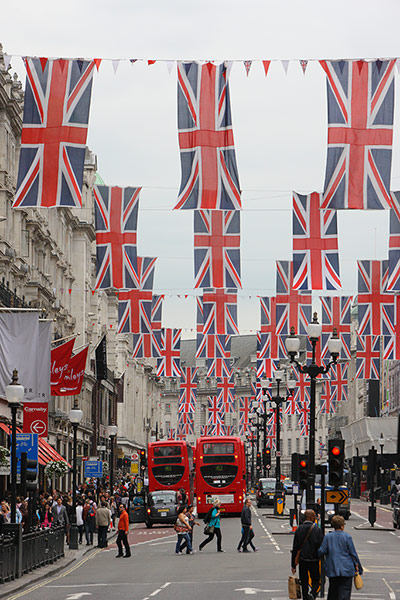
For any of you who have no idea what is going on, all this blather is because this weekend in Britain is the Queen's Diamond Jubilee: the sixtieth anniversary of the beginning of her reign. The specialness of such an event may be undermined by last year's Royal Wedding, and by the Golden Jubilee of 2002, but it's still a big deal: Diamond Jubilees don't come along too often. In fact this is only the second in over a thousand years.
So yes, there is bunting and flags. This picture up on the left is of Regent Street in London. When I look at it, I don't see a crushing authoritarian state lacking in self-confidence, I see a party. That's what a jubilee is, it is a party.
There's a very good reason why the flags are not a problem, why celebrating the Jubilee is not a problem, why having a monarchy at all is not a problem: deep down we know that none of this really matters.
If you want to see crazy flag-waving, come to America. The British put up flags for special occasions (coronations, jubilees, weddings, World Cups), but Americans fly the Stars & Stripes permanently. Everywhere. And some of them are so big, an aircraft carrier could use them as a blanket. Each school flies a flag outside and every classroom inside has one as well. Car showrooms fly hundreds off them. Houses have them staked out on the front lawn. I've even seen cars flying flags, and I don't mean the Presidential limousine. When White Vans sport an England Flag for the football, we roll our eyes, but can you imagine someone driving around like that all the time?
It's a mania, a kind of hysteria that has become utterly normal. And it has to be that way because America is an artificial country, a pure idea and not a cultural accretion. Patriotism is essential here because it is the glue that forces all these disparate peoples to combine. That's why school children are made to take the daily Pledge of Allegiance: the idea of America has to be constantly reinforced lest it suddenly vanish.
The irony is that the idea of America is not under threat at all, even though the anxiety seems to have been hard-wired into the national psychology at birth. Whereas in Britain, where the dangers of Scottish independence actually might destroy a four hundred year old union, we don't tend to worry about such things. On some level or other we have no doubt about who we are.
That's not to say that the idea of Britishness is not a turbulent one. It changes, we argue over it, we even, sometimes, fight each other (or someone else) about it. But for a long time things have been settled and even if Scotland did run off, it is likely that it will still have the same Queen as England. The monarchy plays a crucial role in this, the cherry on top of the Cake of State, but please don't confuse this with power or relevance.
I used to be a monarchist, when I was younger, even though I sympathised with republicanism. To square this circle my position became this: that if I were ever to start a country from scratch then certainly it could only be a republic, but that, seeing that we had the Queen and the monarchy and the heritage, it would be silly for Britain to get rid of all that. I know that there are some who find it intolerable that our head of state inherits the job from their parent, and that to persist with it, even ceremonially, is a kind of tyranny. But to obsess about this, to actively pursue a change to our constitution to remove the monarchy, is to utterly waste time and energy that could be devoted to fixing real problems.
That's why I can't call myself a monarchist because that would imply that there was a debate to be had on the subject and there really isn't. There is no arguing with the fact that sovereignty resides with the people. When this was last up for discussion we made the point by arresting Charles I and chopping off his head. That the monarchy was subsequently restored does not change anything at all. From then on, the crown became our possession, to do with as we please and we have not hesitated to make our displeasure known.
In 1688, we kicked out James II and invited William of Orange to be king instead. We picked George I in 1714 and after that we were happy for a while. But in 1936 the unsuitable Edward VIII was forced aside and we made his brother the Duke of York become George VI. If we chose to celebrate the Diamond Jubilee of his daughter, Elizabeth II, it might be because we're pleased with our own selection process. There are more dark mutterings about the next one (this is especially worrying) but there is a limit to the damage a bad king can do. If we have to put up with a dotty old loon for a few years, we will. If it begins to look like he's not worth the grief then we'll simply push on and have William instead. They belong to us, not the other way around.
Yes, the monarchy costs us money - but only about 72p each per year. And yes, they are horribly rich and unelected. But the world is full of people who are horribly rich. Compared with most of the people in the world you are horribly rich. And if you want to have a go at unelected power in Britain then let's demolish the global media empires, let's sort out the corporate lobbying system, because these are the institutions that really do own us. Let's get hereditary peers and the Bishops (bishops!) out of the House of Lords. That would be a good day's work.
It'll have to wait until Wednesday of course because of the Jubilee, so in the meantime have a slice of cake and a cup of tea, wave a Union flag (ironically, if you must) and watch the best bloody broadcasting corporation in the world show off our country, our heritage and that nice little old lady whose life we hijacked when she was 10 years old.
She has been one of the good ones and is worth celebrating.
Friday, 23 March 2012
A Tiny Slice of Canada with a New York Chaser

I did something unnatural the other day. I crossed a land border into a new country. To some of you that won't sound like too much of a big deal, but to the English this is an alien concept. We prefer our international perimeters to be described by large bodies of water, and this partly explains why cries for Scottish, Welsh or even Northumbrian independence might confuse us. Why bother having a separate country if one can just walk there? Well, that's what you get for growing up in a cul-de-sac, I suppose.
Such rules can not be applied to the vastness of North America and, to be fair, the Niagara river that divides the USA from Canada is large enough perhaps to give even the most insular Englishman pause for thought. But after a plethora of road tolls on the way there, the border checks to get into Canada didn't really seem that much of a big deal. If anything, it was an unexpectedly convivial process. Not that this should in any way be taken as a sign that Canada isn't a 'proper' country: Americans take note, one doesn't judge a nation's greatness by how difficult or unpleasant it is to get into it.
On another occasion we might have fooled about with the idea of driving to the border from Texas, but it's not really feasible during Spring Break. Another time, perhaps. No, we flew to New York to stay with cousins (my wife has cousins everywhere) and drove from there. A trifle of a drive, really, just four hundred miles or so. We took our time.
The road winds up through perfectly rounded hills, its path endlessly criss-crossed by shallow river-beds. The water is dark, winter-cold and dashed with pale rocks and stones. The hills are covered with countless bare trees so that their outlines are softened to a faint grey blur. When the land does flatten it is thick with fur-brown grass, like the countryside has its own winter pelt.
It was nice to be up in the North of the world again. A mixture of oddness and familiarity. I realised I miss even the subtlest of things: the low angle of winter sunlight; the way shadows pool up in the sharp valleys, in the lee of hills; it's an intricate landscape, chiselled and sculpted. There isn't much in the way of topography in my part of Texas and none at all in the city, of course. Even if you do get out west, the land is smashed flat, hammered into an expanse of grassy plains or beautifully desolate desert.
The road in to Ithaca, NY was vertiginous in comparison, rising up over the brim of yet another hill before plunging down into the city. We only stopped for dinner but I liked it. I didn't realise that it was the home of Cornell University, but I should have guessed it was something like that: there were too many cool-looking young people around for it to be an ordinary out-of-the-way small town. From there it was another hour or so, driving through the pitch dark between invisible finger lakes to Geneva, and then in the morning we headed for the border.
It is weird that America is so big. It is unhelpfully large, so much so that I can see, just a little bit, why there are crazy people here who are scared of the federal government or think that their state should be able to ban contraception or what have you. Even I had come to the point, I realised, where I was starting to think of the states as individual proto-countries. Texas is so different from New Mexico, let alone New York, that I had begun to think of them as distinct areas, mis-matched patches in an ungainly American quilt. And then I crossed a real frontier into a real foreign country and I was forced to squeeze the 50 states back into the small box in my head labelled "America", mixed and muddied together like poorly-managed playdough. And, having, done that, I had to try and come to terms with Canada, a country which looks just like America, but which has the Queen on their money.
So, yes, we did Niagara Falls. The horseshoe falls are the big ones and, to be fair, it is impressive. The falls are nagging, insistent, unrelenting. If you ever had to do anything like woodwork at school then I expect you've forced a rod of dowling against the wheel of an electric sander, pressing it forwards so that it is inexorably shwizzed into wood dust. Well Niagara is like that. Relentless and inescapable. No photo can do it justice because it is always thundering and always in motion, continuously dragging the eyes over and down, over and down, over and down until one gives up the fight and lets them rest against the white-out of the gently coiling mist.

The worst bit (or the best bit, depending on your inclination), is the part of the path that somehow goes around the top of the falls so that one is just a couple of metres from the very lip itself. I stood there, caught in a single rolling instant of time, watching the same water rush over and disappear into the event-horizon itself. The sunlight stabbed down, slicing through the water so that I could see just how deep it was at the edge. It also made the water shine, translucent like thick glass, so that I could almost see through the apex. But never for very long. Always the thunderous flow would drag me on with it and I'd be back again to the comparative calm of the lower river: the smoke-blue water giddily spinning and foaming; the mist falling as rain; the permanent rainbow; the hundreds of gulls, wheeling and diving, black against the whiteness.
In my imagination I had always seen it as being set in a wilderness, rather like the Grand Canyon. But no, it has two towns wrapped about either side of it: Niagara Falls, NY, which is rather rugged and a little decrepit in a post-industrial way, with a rather ugly shiny nub of downtown, and Niagara Falls, ON, which is a little tacky. It's got some nice buildings, some lovely houses but it also has a stretch of crap amusement arcades, wax work displays and over-priced pizzerias. For the deeper pockets, there's the casino - the upmarket end as it were. The boys went on a ferris wheel and then we went up the Skylon Tower. Both offered excellent views of the wider landscape and therefore options for escape.
We carried on to Hamilton, ON to stay the night with cousins (my wife has cousins everywhere, did I say?). It was another of the most fleeting stops, but we had a lovely time. We got to shop in a real Canadian store and we got to walk along the hill and stare out over another Great Lake, Ontario. In the very dimmest distance we could see the faint skyline of Toronto.
Annoyingly this first trip was only a series of first impressions, but I like what I saw of Canada. It was suddenly exotic and exciting to see something other than the Stars & Stripes flying, and it was rather wonderful to see kilometers and French words on the road signs. But is this a kind of knee-jerk homesickness? After all, even New York feels like Britain after a winter in Texas. I don't know. It is nice to see that the USA, which can sometimes believe itself to bestride the whole world, doesn't even fill North America. And Canada is such a fascinating idea, a parallel-universe Bizarro America, tinged by another century or so of British rule. Having seen it for myself, I think I understand the country a little now, I have a better sense of how it plugs into the world. It's worth exploring properly and I hope that I will get a chance to do that one day.
We spent the whole day driving back to New York. Surprisingly, getting back across the border was a rather fraught affair, with lots of queuing and waiting and, at the end, a surly American border guard who rolled his eyes at us for trying to navigate the frontier at all. But after that we had a good day's drive. We had possibly the best hot dogs ever at a place called Ted's in Buffalo, NY (America, for good or ill, excels at inexpensive, unpretentious and very tasty food) and then we ploughed on back down the road, through the hills and across the rivers, all looking much the same as they had on the way up, until the sunlight ebbed from the world and the galaxy of lights that is New York city rose up before us.

It's unlikely to happen but we did get to spend a day chipping away at the mystique and I fixed down some of the things I half-remembered from previous visits. This felt good but of course there was no defence against stumbling into new unforeseen wonders or, worse still, foreseen ones.
For example, I knew Grand Central Station was impressive, but seriously? For the first time, I arrived in New York by train and it took a long while to get out of that building. I had expected it to be grand. I hadn't expected it to be exquisite and banded by its own blue vaulted heaven of sky and stars.
Once outside, we ambled. Battery Park to stare across at the Stature of Liberty, then back uptown. On a whim we poked our noses inside the Schwarzman building - the branch of the New York Public Library at 5th Avenue and 42nd Street - only to find another palace. Like a Tuscan church its white stone and marble gives away to a beautiful interior of carved dark wood and luscious frescos. The Reading Rooms were full of people, studying and researching, their gaze split between page and screen - libraries aren't just for storing books, they are for helping knowledge and information to spread freely, regardless of the medium.
With the time we had left we took a walk along the High Line, an old elevated railway line that has been reclaimed as a public park. Initially I was underwhelmed: I hadn't come to New York city to encounter calm or quiet. But as we strolled along above the streets and the traffic I took to it. It's fun to share the space with other pedestrians, to see the backs of buildings and to enjoy the odd vantage points: a secret version of the city hidden away amongst the air rights, which is after all exactly the sort of thing I had been hankering after. Best of all, being an old train line, the High Line actually took us somewhere. Rather than walking around a park to end up where we had started, our stroll had taken us to our destination. Or rather the next in a series of destinations, a series that ended, finally, late that night with us rolling up to the door of our home, way down south.
Thursday, 24 November 2011
Thanksgiving
I think it's fair to say that I am still not fully engaged in American life. Partly this is inertia on my part - I miss a lot of British things and enjoy trying to cling to them. But it is also that there is so much to learn. Not having grown up here means there's stuff I'll never get. I'll never have a college football team, or a home state. I'll never vote for a President. And there are so many traditions, customs and holidays that I haven't grown up with and probably won't ever truly understand.
And that's fine. I prefer Remembrance Sunday to Veterans' Day. I'd rather celebrate the 5th of November than July 4th.
But if I ever do go back to the UK, I would like try and take Thanksgiving back with me. It's a brilliant holiday and one which I can fully endorse. It's simple and easy, just good food and loved ones, and it serves as a legitimate starting gun for Christmas. Of course, I don't have an unruly feuding extended family that I have to cater for, so I'm guessing that some Thanksgivings are less fun and more complicated than others. I'm also aware that we aren't doing it quite properly. Although we can manage a green bean casserole, one of many delicious side dishes that differentiate Texan Thanksgiving from British Christmas dinner, we'll not be deep-frying a turkey and I won't be passing up on roast potatoes or parsnips.
But this is surely the glorious thing about Thanksgiving - it transcends America because at the core is a universal idea. I don't give two hoots for the Pilgrim Fathers, but I do have plenty to be grateful for. We all do, of course. I'm grateful for my incredibly hard-working wife and my indefatigable children. I'm grateful for my amazing family and friends. The giants of my life: my parents, my siblings, my school, university and other friends I've left behind in Britain. But also the new friends and new family I've found here in America, all startling and unlooked for, but heartbreakingly generous and welcoming. I'm grateful to be able to sit outside in my shirt sleeves in November. I'm grateful for the restorative powers of tea, toast and Marmite that are gently pushing the edges of a mighty hangover from my brain. And I'm grateful that this day exists: a day to remember how lucky and loved I am; a day to give thanks.
And that's fine. I prefer Remembrance Sunday to Veterans' Day. I'd rather celebrate the 5th of November than July 4th.
But if I ever do go back to the UK, I would like try and take Thanksgiving back with me. It's a brilliant holiday and one which I can fully endorse. It's simple and easy, just good food and loved ones, and it serves as a legitimate starting gun for Christmas. Of course, I don't have an unruly feuding extended family that I have to cater for, so I'm guessing that some Thanksgivings are less fun and more complicated than others. I'm also aware that we aren't doing it quite properly. Although we can manage a green bean casserole, one of many delicious side dishes that differentiate Texan Thanksgiving from British Christmas dinner, we'll not be deep-frying a turkey and I won't be passing up on roast potatoes or parsnips.
But this is surely the glorious thing about Thanksgiving - it transcends America because at the core is a universal idea. I don't give two hoots for the Pilgrim Fathers, but I do have plenty to be grateful for. We all do, of course. I'm grateful for my incredibly hard-working wife and my indefatigable children. I'm grateful for my amazing family and friends. The giants of my life: my parents, my siblings, my school, university and other friends I've left behind in Britain. But also the new friends and new family I've found here in America, all startling and unlooked for, but heartbreakingly generous and welcoming. I'm grateful to be able to sit outside in my shirt sleeves in November. I'm grateful for the restorative powers of tea, toast and Marmite that are gently pushing the edges of a mighty hangover from my brain. And I'm grateful that this day exists: a day to remember how lucky and loved I am; a day to give thanks.
Sunday, 11 September 2011
Diminishing Ripples
I was going to write something sober and reflective, trying to find some long-term perspective for the terrorist attacks of the 11th of September, 2001. Having logged on, I found this piece by Francis Fukuyama in the Guardian. It is brilliant and brief, offering succinct and incisive analysis. Timothy Garton-Ash put forward similar thoughts earlier in the week.
What they don't offer, what no dispassionate or clear-headed perspective can provide, what a lot of Americans still need, is comfort and reassurance. Because, unfortunately, there is none to be had. This has always been a dangerous world where terrible things can happen suddenly and irrevocably, and there is no policy, weapon or faith that can guarantee individual safety.
The unimaginable impact of that day will never diminish for those who were injured, for those whose friends or family were killed, or for those who witnessed the disaster first hand and escaped. But it would be a tragedy for America, let alone the world, if our future history continued to pivot around this black day.
What they don't offer, what no dispassionate or clear-headed perspective can provide, what a lot of Americans still need, is comfort and reassurance. Because, unfortunately, there is none to be had. This has always been a dangerous world where terrible things can happen suddenly and irrevocably, and there is no policy, weapon or faith that can guarantee individual safety.
The unimaginable impact of that day will never diminish for those who were injured, for those whose friends or family were killed, or for those who witnessed the disaster first hand and escaped. But it would be a tragedy for America, let alone the world, if our future history continued to pivot around this black day.
Wednesday, 8 June 2011
Return of the Native
There it was: the first tiniest hint that my brain has been rewired for America.
The man in the shop looked on, his smile becoming increasingly waxy, as I tried again and again to swipe my card to pay for my purchase. Every now and again he would say, in a dull unbelieving voice, "No, insert your card please," and I would swipe again. We stood there, trapped in a loop, for about a day and a half.
Chip & Pin! Yes, of course, the card goes in like that. But definitely not a new thing, definitely introduced in the UK before I left. I had just forgotten. And this doesn't matter either, wouldn't matter, except for the fact that I had no obvious excuse.
In America, my accent allows me to be ignorant of all sorts of things. I can ask stupid questions all day long and people are delighted to help. But when I stood there in the shop, with my British accent and my British bank card, the man had no reason to assume I had been America for three years. In his eyes I was just an idiot who bumbled along not knowing how to buy things.
And then sometime later, I had to navigate a mini roundabout. Total chaos. Worse because there are roundabouts in America (some in New England and two in Houston if you can believe such a thing) but, of course, they spin the other way, like the fabled antipodean plug holes.
These were just hurdles and I'm over them now, having reasserted submerged behaviours. But I did not expect coming back home to pose such problems, that familiar and known things could be obstacles. I shouldn't have to work things out like I'm in a foreign country.
But I do.
Friday, 18 March 2011
Backwards
Thanks to the magic of technology, I am writing this on the road. Literally, somewhere along the I-40, eastbound, just shy of Albuquerque and heading for Santa Rosa, New Mexico.
It's roughly ten at night. On either side, the desert is a flat black slick despite the light of the full moon high above us. It sits behind a veil of diaphanous cloud that stretches almost to the horizon. The boys are asleep behind us. Laura is driving. We are coasting along on the ceaseless thrum of our wheels on the road, over which we can just hear Flanders & Swan dropping another hat. The cabin is lit by orange dials and passing cars.
I love this bit. Even as a passenger I still relish the sense that we are making progress, chewing up miles and states and gradually, forcibly, bringing our destination closer.
Satisfying though this is, it can't and doesn't detract from the fun we have when we stop and look about. We managed to do a lot of this today as well.
We sauntered around a thousand year old lava flow at Sunset Crater, AZ. It looked freshly ploughed, an avenue of great chunks of clinker and black sand from which these beautiful Ponderosa Pines had sprouted.
And then we clambered around some similarly aged cliff-dwellings, hewn from the wall of the (modestly sized) Walnut Canyon by ancestors of the Hopi tribe of Native People. It was a strenuously peaceful walk: the cool stone weaves between the sunlight and the shadows of trailing trees. The only sounds, the wind and the caws of ravens.
But before all that we had to tear ourselves from a grander canyon. Long ago, in the dark, we got up, wrapped ourselves in all our clothes and set out to watch the sun rise over the rim. Funnily enough, in the dark the abyss isn't anywhere nearly as scary and I was able to perch happily on the low wall above the drop to wait for the sun to peep. The sky faded to grey and below us the rippling folds of rock gradually materialised from the murk, like leviathans swimming up from the depths. And then finally a needle of orange light pierced the gloom and the canyons burst into colour.
It's roughly ten at night. On either side, the desert is a flat black slick despite the light of the full moon high above us. It sits behind a veil of diaphanous cloud that stretches almost to the horizon. The boys are asleep behind us. Laura is driving. We are coasting along on the ceaseless thrum of our wheels on the road, over which we can just hear Flanders & Swan dropping another hat. The cabin is lit by orange dials and passing cars.
I love this bit. Even as a passenger I still relish the sense that we are making progress, chewing up miles and states and gradually, forcibly, bringing our destination closer.
Satisfying though this is, it can't and doesn't detract from the fun we have when we stop and look about. We managed to do a lot of this today as well.
We sauntered around a thousand year old lava flow at Sunset Crater, AZ. It looked freshly ploughed, an avenue of great chunks of clinker and black sand from which these beautiful Ponderosa Pines had sprouted.
And then we clambered around some similarly aged cliff-dwellings, hewn from the wall of the (modestly sized) Walnut Canyon by ancestors of the Hopi tribe of Native People. It was a strenuously peaceful walk: the cool stone weaves between the sunlight and the shadows of trailing trees. The only sounds, the wind and the caws of ravens.
But before all that we had to tear ourselves from a grander canyon. Long ago, in the dark, we got up, wrapped ourselves in all our clothes and set out to watch the sun rise over the rim. Funnily enough, in the dark the abyss isn't anywhere nearly as scary and I was able to perch happily on the low wall above the drop to wait for the sun to peep. The sky faded to grey and below us the rippling folds of rock gradually materialised from the murk, like leviathans swimming up from the depths. And then finally a needle of orange light pierced the gloom and the canyons burst into colour.
Thursday, 17 March 2011
Down
I've never been good with heights, particularly, but I'm often okay. Good enough anyway to cope with the Empire State Building and castle turrets.
I can't cope with this. The thought of the spectacular drop off the side of the South Rim of the Grand Canyon is enough to turn my vital organs to jelly. Even here, at a relatively safe distance of a mile or so from the edge, I'm not comfortable. I may never be comfortable. Maybe just knowing it is there, behind me somewhere in the desert, will be enough to interrupt my sleep from time to time for the rest of my life.
My sense of scale, having already been tested by the journeys and vistas I have experienced around America, has now been tortured too. The canyon is ten miles across and more than a mile down. A mile down. A beautiful, magical, breath-taking mile down. But you wouldn't want to take the short cut.
Apparently people only fall very rarely, but you'd never believe it from the way people skip and prance around the paths, or swing their legs out over the precipice, just to have their photo taken. The wilful ignorance or denial of their own mortality is taken as a personal affront, obviously. It's bad enough that I have my children with me ("Dad, puhleese, I DO know what I'm doing"), but every step or pose struck by my fellow visitors is like a knitting needle jabbed straight into my jangling nerves.
I can't help it. People may only fall very rarely, but when they do, they always fall to their deaths. The potential is what terrifies me, the sudden irrevocable moment where a holiday turns to a tragedy. I am a big scaredy cat according to my kids, but I can't help but think that the Grand Canyon would be even more beautiful and amazing experienced from the bottom. The only way to find out is to come back here and walk down the cliffs of course, but I can't help but be convinced I would become happier with every step.
I can't cope with this. The thought of the spectacular drop off the side of the South Rim of the Grand Canyon is enough to turn my vital organs to jelly. Even here, at a relatively safe distance of a mile or so from the edge, I'm not comfortable. I may never be comfortable. Maybe just knowing it is there, behind me somewhere in the desert, will be enough to interrupt my sleep from time to time for the rest of my life.
My sense of scale, having already been tested by the journeys and vistas I have experienced around America, has now been tortured too. The canyon is ten miles across and more than a mile down. A mile down. A beautiful, magical, breath-taking mile down. But you wouldn't want to take the short cut.
Apparently people only fall very rarely, but you'd never believe it from the way people skip and prance around the paths, or swing their legs out over the precipice, just to have their photo taken. The wilful ignorance or denial of their own mortality is taken as a personal affront, obviously. It's bad enough that I have my children with me ("Dad, puhleese, I DO know what I'm doing"), but every step or pose struck by my fellow visitors is like a knitting needle jabbed straight into my jangling nerves.
I can't help it. People may only fall very rarely, but when they do, they always fall to their deaths. The potential is what terrifies me, the sudden irrevocable moment where a holiday turns to a tragedy. I am a big scaredy cat according to my kids, but I can't help but think that the Grand Canyon would be even more beautiful and amazing experienced from the bottom. The only way to find out is to come back here and walk down the cliffs of course, but I can't help but be convinced I would become happier with every step.
Subscribe to:
Posts (Atom)